
Bread and Roses, Too
Hungers of body and soul

Dear Bread Readers,
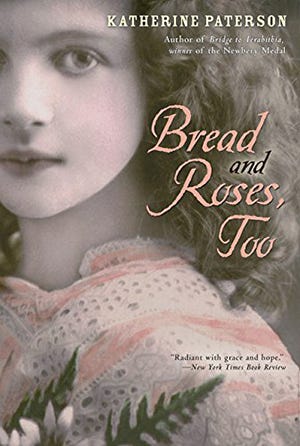
I finished reading Katherine Paterson’s Bread and Roses, Too — a YA novel about the 1912 Lawrence, Massachusetts textile workers’ strike. The initial walkout of 2000 workers was incited by the state-mandated 54-hour work week. Mill owners cut pay to compensate for the new law, and workers left their position on the factory floor, calling “Short pay, all out!”
The strike had tremendous momentum. For more than two months, 25,000 Lawrence workers held their ground. The International Workers of the World, the IWW sent organizers. Police shot firehoses at strikers, but it didn’t quell the dissent. State militias set up encampments in the factories. A boy was stabbed with a bayonet. A woman was shot, and her death was blamed on radicals, but traced to law enforcement.
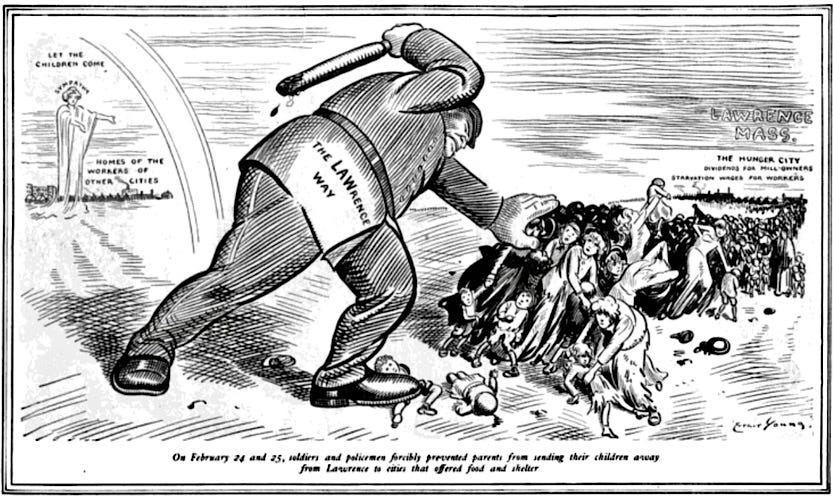
Unions around the country sent financial support. IWW organizers, including Elizabeth Gurley Flynn, made a plan for children to leave the turmoil and live with families in New York City, Philadelphia and Barre, Vermont. The idea was to feed the children, and help strikers hold strong.
Paterson’s novel starts in Lawrence, and follows the main character Rosa to Barre, where she’s placed with an Italian family, part of a strong immigrant community of stonecutters. (I felt bread kinship there because New American Stone Mills, which makes mills for many fresh milling bakeries and regional flour mills (and which is recovering from a devastating fire), uses Barre Gray Granite. I liked learning a piece of the history of that area.)
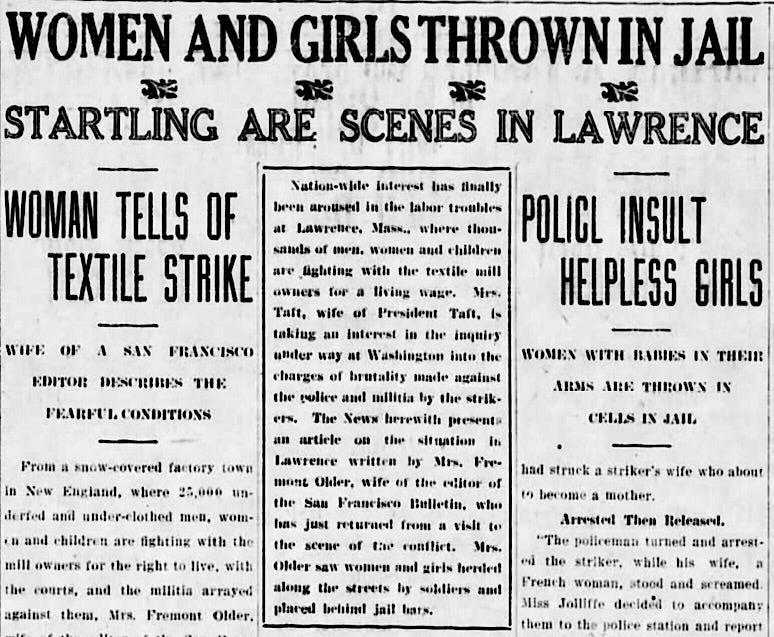
In Barre, Rosa learns about the horrible attack that police made on women and children at the Lawrence train station. As women readied their kids for another transport, police incited a riot. In a letter from her sister, Rose learns that her mother went to jail and her little brother was lost — in another letter, she learns everyone is okay.
In a note at the back of the book, Paterson acknowledges that there is no evidence of the phrase “bread and roses” appearing in images or contemporary reports of the strike. However, in the book she imagines an origin scene: Rosa’s mother comes up with the sentiment of needing roses as well as bread, and Rosa inks a pasteboard sign and this phrase is carried through the strikes.
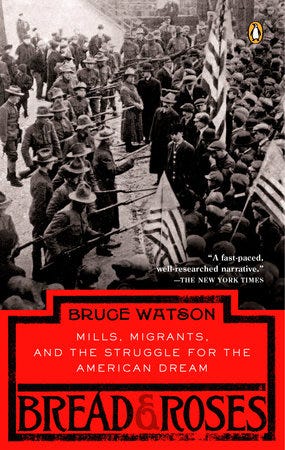
I got this book out of the library to research the strike a little further. A few years back, I read Bruce Watson’s nonfiction Bread and Roses: Mills, Migrants and the Struggle for the American Dream. Reading that inspired me to do something with my local YWCA, the YWCA-GCR, and we had the first Bread and Roses Luncheon for International Women’s Day. Monday March 9th we are eating together again, and bringing roses to residents at the Y, and thinking about what it means to help each other and fight.
I’ve written a bulletin for this year’s meal, and we are going to sing the song that’s become shorthand for sustenance and dignity. I’ll leave you with my favorite line from the poem/song:
Hearts starve as well as bodies: Give us Bread, but give us Roses.
Yours, Amy
BREAD AND ROSES
BY JAMES OPPENHEIM
“Bread for all, and Roses, too”—a slogan of the women in the West
As we come marching, marching, in the beauty of the day,
A million darkened kitchens, a thousand mill-lofts gray
Are touched with all the radiance that a sudden sun discloses,
For the people hear us singing, “Bread and Roses, Bread and Roses.”
As we come marching, marching, we battle, too, for men—
For they are women’s children, and we mother them again.
Our lives shall not be sweated from birth until life closes—
Hearts starve as well as bodies: Give us Bread, but give us Roses.
As we come marching, marching, unnumbered women dead
Go crying through our singing their ancient song of Bread;
Small art and love and beauty their drudging spirits knew—
Yes, it is Bread we fight for—but we fight for Roses, too.
As we come marching, marching, we bring the Greater Days—
The rising of the women means the rising of the race—
No more the drudge and idler—ten that toil where one reposes—
But a sharing of life’s glories: Bread and Roses, Bread and Roses.
Notes:
For tickets to this year’s luncheon, go here: Bread & Roses: International Women’s Day Luncheon — YWCA of the Greater Capital Region
In September 1911, in the American Magazine, suffragist Helen Todd wrote about the meaning of the phrase that suffragists were using: “bread for all, and roses, too.” Oppenheim’s poem was published in December 1911 in the same publication.
Jewish labor leader Rose Schneiderman spoke in Lawrence shortly after the strike, and her work for workers became called the Bread and Roses movement.
I have great faith in Katherine Paterson because she wrote A Bridge to Terabithia, a book that is a part of my childhood. It came out in 1977, when I was ten and it feels like I lived in that book, or that I lived the story. It is so beautifully rendered, a world of childhood friendship and the woods and the spaces in between people and trees and streams that we fill for each other. The story hit me especially hard because it involves the death of the main character’s friend; in 1976, my grandparents were killed in a car crash. But I don’t think my personal brush with loss made the book more successful. I believe Paterson has an extraordinary gift for inviting you into a realm.
At the 1/1/26 inauguration of Zohran Mamdani as NYC’s mayor, Lucy Dacus sang “Bread and Roses”:
https://m.youtube.com/watch?v=ftVpyoSUpt8&pp=ygUkTWFtZGFuaSBpbmF1Z3VyYXRpb24gQnJlYWQgYW5kIFJvc2Vz
As always, beautifully written and powerful. Keep up the great work in times of extreme difficulty for so many. What you do is important. Thank you. Bill